Responsibility matrix
WMS, WCS/WES, PLC, fleet management, vehicle, infrastructure and site operations owners are named for normal and fault states.
Capture the minimum evidence needed to compare warehouse robotics concepts without hiding route, traffic, interface or acceptance assumptions.
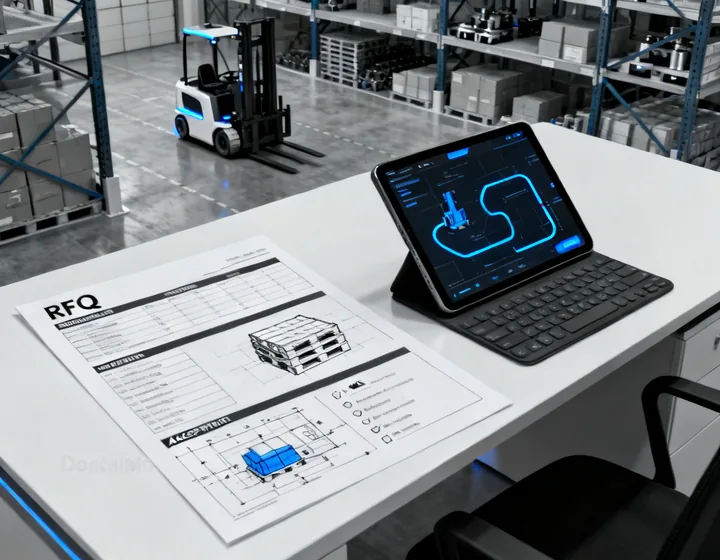
A blank field is not automatically a blocker. It is an action with an owner and a date, which is more useful than filling the RFQ with an unverified number.
| Group | Required input | Unit / evidence | Status |
|---|---|---|---|
| Load | Mass, dimensions and load center | kg and mm; representative load drawing | Measured / assumed / open |
| Pickup and drop tolerance | mm; pallet or carrier condition | Measured / assumed / open | |
| Load exceptions | Damaged, shifted, absent or rejected load | Procedure owner | |
| Flow | Baseline movement rate | Loads/hour by route | Observed period |
| Peak case | Loads/hour and peak duration | Order or production profile | |
| Buffer occupancy | Usable positions and release logic | Normal and blocked states | |
| Route | Clear width, turns and slopes | mm, degrees and floor survey | Drawing revision |
| Shared traffic | Crossings, manual trucks, pedestrians | Traffic plan | |
| Charging | Location, access and operating rule | Duty-cycle assumption | |
| Interfaces | Task source and acknowledgement | WMS/WCS/WES message contract | System owner |
| Field devices | PLC, doors, conveyors and signals | I/O and state diagram | |
| Exception recovery | Timeout, retry, cancel and restart | Authority matrix |
This checklist does not assert certification. It identifies documents and review boundaries that may be required for the selected model, market and site.
WMS, WCS/WES, PLC, fleet management, vehicle, infrastructure and site operations owners are named for normal and fault states.
Applicable ISO 3691-4 and ISO 13849-1 considerations, risk reduction, scanner zones and validation responsibilities are reviewed for the actual configuration.
Emulated systems, representative loads, test preconditions, expected results, logs, exclusions and issue closure are documented.
Site routes, traffic, interfaces, loads, peak case, degraded behavior and restart authority are observed in the installed environment.
Work zones, available routes, fallback movement, commissioning windows, training and authorization protect the live warehouse during rollout.
Open items, as-built records, diagnostics, maintenance, critical spares, recovery procedures and support boundaries have named recipients.
Fleet quantity, throughput, availability and charging demand cannot be confirmed from a generic checklist. They require a bounded model using route length, load profile, speeds and waits, traffic interaction, task logic, battery strategy, buffer occupancy and exception frequency. Compare both ideal flow and a defined disturbed case.
When comparing concepts, score the same dimensions: rated load with load center; aisle / clear width in mm; design and peak loads/hour with SKU or order profile; interface cycle time and exception timeout ownership; system availability assumptions at vehicle, fleet and end-to-end levels; and whether the path is greenfield optimization or brownfield phasing. Prefer the concept that closes the highest-risk dimension with measurable evidence, not the one with the broadest marketing claim.
Verification path available on request: representative load trial on a mapped route segment, controls-message emulation for timeout and duplicate-call cases, and joint review of the FAT/SAT exclusion list with the site operations owner.
Identify confidential attachments before transmission and request an agreed secure channel when needed.