Flow map before fleet count

BALYO warehouse robotics starts with the route

Define load units, pickup and drop geometry, shared traffic, WMS or WCS handshakes, charging and exception recovery before comparing autonomous forklift quantities.
Open RFQ Data Sheet
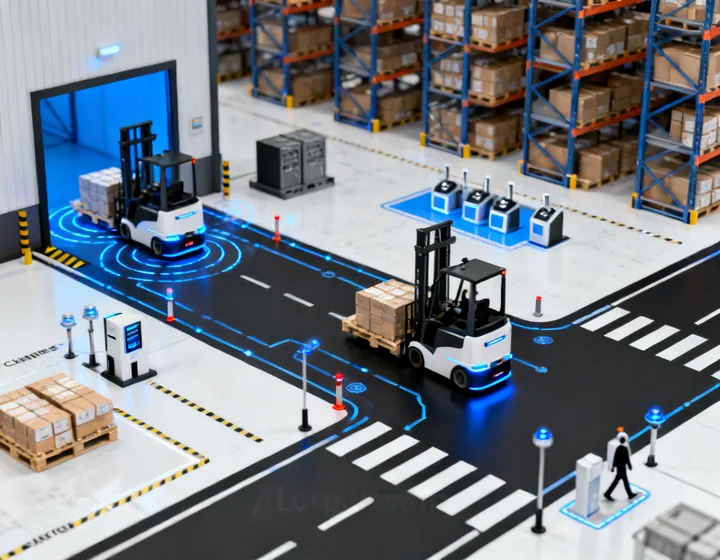
Warehouse flow map with autonomous forklifts moving between receiving, storage, picking and shipping
ReceiveStoreMoveShip
Design rateLoads/hour with route and peak windowInput basis
FATFleet states within the factory boundaryTest scope
SATSite traffic, interfaces and representative loadsRelease gate
Product by flow stage

Position each robot task inside the warehouse sequence

Equipment is evaluated against the movement it performs and the systems, people and buffers around it.

01 Receive

Trailer-to-buffer transfer

Confirm pallet condition, pickup geometry, staging occupancy and pedestrian controls.

02 Store

Putaway movement

Map aisle width, turning envelope, rack interface and blocked-location recovery.

03 Move

Replenishment route

Define calls, priority, congestion and handoff with production or picking.

04 Pick

Goods movement support

Coordinate tote or pallet presentation, operator zones and completion messages.

05 Buffer

Accumulation control

State capacity, release logic and behavior when downstream equipment is unavailable.

06 Ship

Outbound staging

Link sequencing, lane assignment, scan confirmation and exception handling.

Requirement groups

Compare concepts against the same input set

Values below are RFQ fields, not published BALYO model claims. Record measured ranges and test conditions for the actual site.

Load & geometry
Rated loadkg, dimensions and load center
Route envelopeClear width in mm, turns, slopes and floor conditions
Flow & controls
System throughputLoads/hour by baseline and defined peak window
Interface cycleWMS/WCS/fleet handshake, timeout and acknowledgement
Safety & recovery
Traffic boundaryPedestrians, manual trucks, crossings and restricted zones
Exception basisBlocked route, lost load, device fault, low charge and restart
Operating profile matrix

The same autonomous forklift task changes by environment

ProfileLoad / SKU patternPeak factorPrimary boundary
E-commerceWide SKU depth, mixed palletsCarrier cutoff surgeCongestion and buffer release
GroceryStore-wave palletsScheduled dispatch waveDamaged-load exception
Cold chainTemperature-zoned palletsDoor-open constraintCondensation and battery context
ManufacturingStable line-side routesShift and takt dependencyMixed manual traffic
PharmaceuticalControlled, traceable loadsBatch and release windowSystem records and access
One bounded RFQ

Send the load, route, rate and interface facts

Separate measured conditions from assumptions. Identify the decision deadline and which acceptance cases must be demonstrated.

Use the RFQ Checklist

Minimum context

  • Load dimensions, mass and pickup tolerance
  • Route drawing and shared-traffic rules
  • Baseline and peak movement profile
  • WMS, WCS, PLC and fleet ownership
  • FAT, SAT and rollout constraints